Chemical processing systems often handle corrosive media that can quickly damage standard metal valves. In these applications, lined control valves provide a practical solution by combining the strength of metal valve bodies with the corrosion resistance of fluoropolymer linings.
Whether the application involves acids, alkalis, solvents, or high-purity chemicals, selecting the correct valve structure and lining material directly affects service life, sealing performance, and maintenance costs.
This guide explains how to select lined control valves, including material choices, valve types, operating conditions, and common mistakes to avoid.
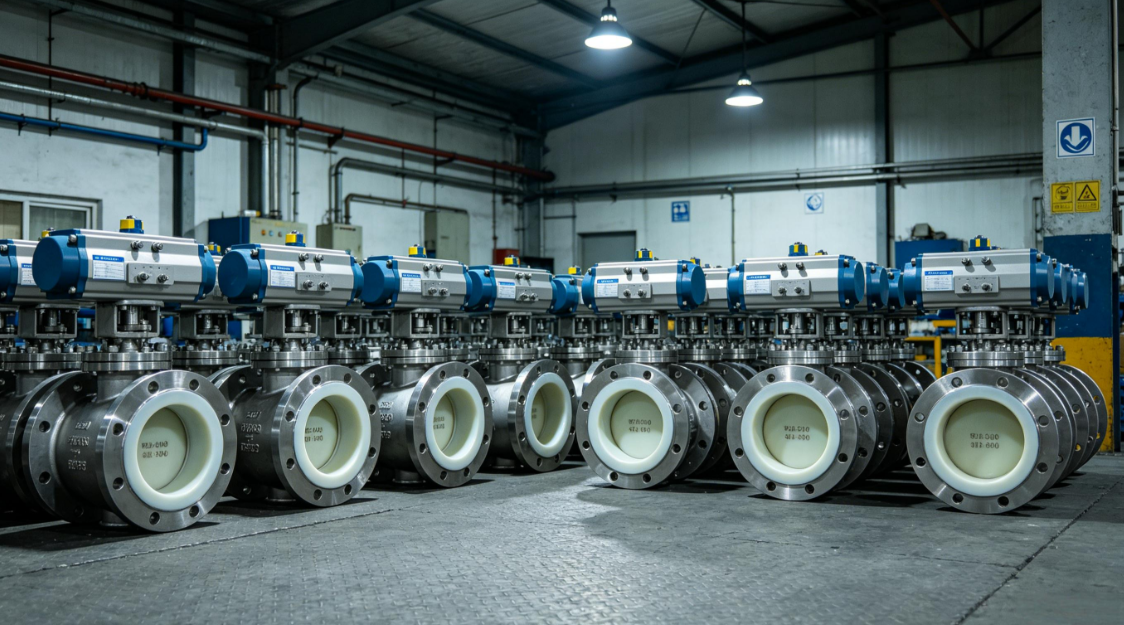
Lined control valves are valves with an internal corrosion-resistant lining bonded to the wetted surfaces of the valve body and trim. The lining isolates the metal body from aggressive chemicals while maintaining flow control performance.
Common lining materials include:
These valves are widely used in:
Among various valve designs, the pfa lined ball valve is one of the most commonly selected options for corrosive applications.
PFA material resists a broad range of aggressive chemicals, including:
PFA lining provides a non-stick surface that reduces scaling and media buildup.
Compared with standard FEP materials, PFA generally performs better in higher-temperature applications.
A properly designed lined ball valve provides tight shutoff and reliable sealing performance.
Different applications require different valve structures.
Lined ball valves are widely used because they provide:
They are suitable for:
These valves are commonly used in larger pipe sizes where lower weight and cost are priorities.
Typical applications include:
Designed for accurate throttling and control.
Best for:
Often selected for ultra-clean or high-purity applications.
Common in:
Always verify that the lining material matches the process media.
| Lining Material | Chemical Resistance | Temperature Range | Typical Applications |
|---|---|---|---|
| PTFE | Excellent | High | Strong acids and alkalis |
| FEP | Very good | Moderate | General chemical service |
| PFA | Excellent | Higher than FEP | High-purity and higher-temperature systems |
PFA lined valves are often preferred when both corrosion resistance and elevated temperature capability are required.
Temperature directly affects lining stability and sealing performance.
Typical considerations:
Always check the manufacturer's actual temperature limits.
Lined valves usually have lower pressure ratings than solid metal valves.
Before selection, confirm:
Vacuum service may require special anti-collapse designs.
Control valves must match the required flow behavior.
Questions to evaluate:
For frequent throttling, globe-style lined control valves are often preferred over standard ball valves.
Improper sizing can cause:
Valve sizing should consider:
Lined control valves can use:
Pneumatic systems are common in chemical plants because of their fast response and compatibility with hazardous environments.
Poor valve selection can lead to:
Many failures occur because the lining material was selected based only on chemical resistance while ignoring temperature, pressure, or cycling frequency.
Sudden thermal expansion can damage fluoropolymer linings.
Pipeline stress and water hammer can deform internal linings.
Incorrect flange alignment can damage sealing surfaces.
Check for:
Used for aggressive acids and solvents.
Suitable for clean process environments.
Applied in chlorine and chemical dosing systems.
Used in corrosive slurry handling systems.
PFA lined valves are often used in ultra-pure chemical transport.
PTFE offers strong chemical resistance and broad compatibility. FEP provides good corrosion resistance with easier processing. PFA combines high chemical resistance with improved temperature performance and smoother internal surfaces.
PFA lined ball valves are commonly selected for:
Standard lined ball valves are mainly designed for on/off service. Limited throttling is possible, but continuous flow regulation may shorten seat life.
For accurate control, lined globe control valves are usually a better option.
The most common industries include:
Service life depends on:
Properly selected lined valves can operate reliably for many years in corrosive environments.
Selecting the correct lined control valve requires more than choosing a corrosion-resistant material. Chemical compatibility, temperature, pressure, flow conditions, and valve structure all influence long-term performance.
For many corrosive applications, pfa lined ball valves provide a balance of chemical resistance, sealing reliability, and operational durability. However, the best valve choice always depends on the actual process conditions.
Careful evaluation during valve selection helps reduce downtime, improve safety, and extend equipment service life.